
December 2, 2025 | Blogs and News, Research
At Children’s Music Fund, we’ve always believed that music helps kids heal. The concept may seem simple, yet we witness it every day in treatment rooms, hospital bedsides, and family living rooms—and now in the Neonatal Intensive Care Unit (NICU).
I recently had the pleasure of participating in an Observational Study, Physiological Effects of Music Therapy in Neonatal Intensive Care Setting, alongside esteemed colleagues, Scott Brown B.S., Hranush Danelyan MD, Renuka Chepuru B.S., Anamika Ghosh M.Ed, and Ara Khoylyan, B.S.
We set out to answer three questions:
1. What are the impacts of one music therapy session in a Neonatal Intensive Care Setting?
2. Are there physiological benefits for completing more than one session?
3. What is the optimal length of a Music Therapy session?
The results are both heart-warming and science-backed. Babies who received just a short Music Therapy session showed measurable physiological improvements, such as calmer heart rates and stronger oxygen levels. At its simplest form, Music Therapy is an effective tool in the NICU to improve vital signs and reduce pain and stress among patients.
For anyone who’s ever hummed a lullaby to soothe a baby, this might not come as a surprise. But to see it documented in medical research? That’s a big deal.
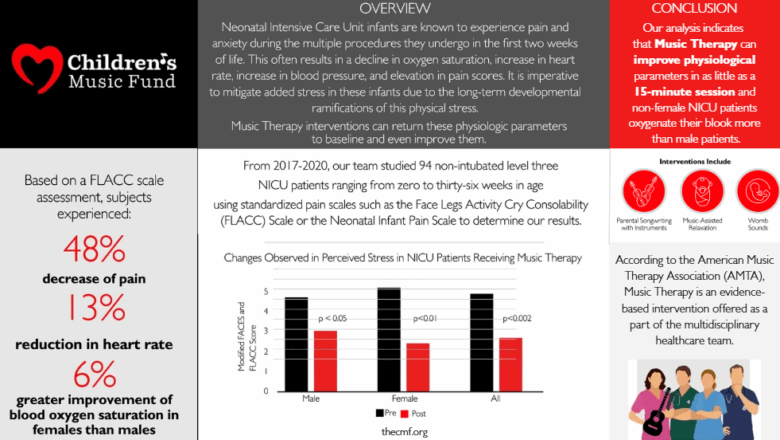
To quantitatively assess physiological changes, we measured pain reduction using FACES and FLACC pain scores, along with cardiovascular monitor measurements before and after a standard Music Therapy session in 94 non-intubated Level 3 NICU patients. Of the 94 participants, 72.9% were Latino/Hispanic, and 53.3% were male.
Results were staggering:
- A 2.2 point (p<0.05) reduction in pain on the FACES score, with no significant difference between genders.
- A 12 beats per min reduction in heart rate and a 3.9% increase in Oxygen Saturation (p<0.05) by the end of the session.
- Overall, patients experienced a 13% reduction in heart rate and a 48% reduction in pain levels.
What does that mean? It only took 15 minutes of Music Therapy for the patients to respond positively, experiencing a significant decrease in pain levels, heart rate, and an increase in oxygen saturation levels. These physiological changes imply an overall improved patient experience after one Music Therapy session.
Why This Matters in the NICU
The NICU can be an overwhelming place. Tiny babies, many born early or facing serious medical challenges, are surrounded by beeping monitors, bright lights, and often distanced from the comfort of their mothers. This study tells us that music can serve as a conduit for improvement, helping babies settle, breathe more steadily, and relax as seen with their vital signs.
That’s what we mean when we say Music Therapy isn’t just “nice to have” or “fun break from treatment” in healthcare. It’s meaningful, measurable care.
For our smallest, most vulnerable patients, Music Therapy is gentle, non-invasive, and deeply personal. And for NICU families who often feel alone or afraid, music becomes an empowering tool to support their child’s healing journey. Every baby, every child, every family deserves access to comfort, connection, and healing, especially in their hardest moments.
We have been bringing Music Therapy to patients for over 20 years, and this study fuels us to go even further. We know music makes a difference for older kids and teens, and now we’re seeing even more momentum for bringing Music Therapy into NICUs too.
We remain deeply committed to our mission of giving children the opportunity to experience the healing power of Music Therapy wherever they are in their treatment journey.
Music heals – and it starts from day one.
This research paper has been published in Psychology Today December 2025 and Advances in Integrative Medicine (AIMED) Volume 10, Issue 1, March 2023, Pages 29-33.
Advances in Integrative Medicine (AIMED) is an international peer-reviewed, evidence-based research and review journal that is multi-disciplinary within the fields of Integrative and Complementary Medicine. The journal focuses on rigorous quantitative and qualitative research including systematic reviews, clinical trials and surveys, whilst also welcoming medical hypotheses and clinically-relevant articles and case studies disclosing practical learning tools for the consulting practitioner.